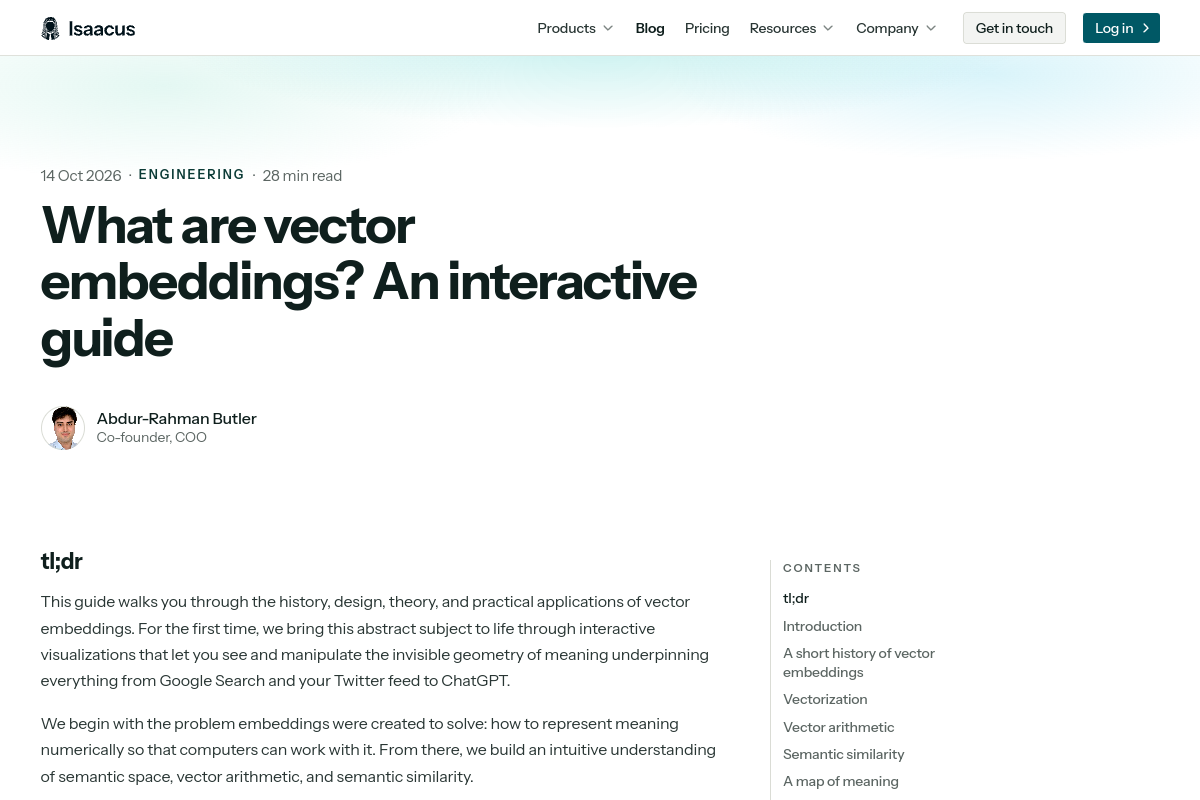
Interface & Product Gallery

Product Specifications

Pricing Model Freemium
Starting Price $0.35/1M tokens
Free Trial $100 free credits (2 months)
Official Pricing Tiers View Complete Pricing Plans →
Ideal Audience & Best For ML Engineers, Data Scientists, Product Managers, Knowledge‑workers building semantic search, recommendation, and document classification
API & Integrations REST API & Webhooks Ready
Community Upvotes ▲ 44 votes by verified community members

Core Capabilities & Features

Interactive Visualizations: Real‑time 2‑D and heatmap displays of vector similarity, letting users explore semantic spaces without code.
Pay‑as‑You‑Go Embedding API: Per‑token pricing with $100 free credits, supporting high‑throughput batch requests via REST.
Built‑in Reranker & Classifier: Pre‑trained Kanon models for zero‑shot classification and relevance reranking, callable via a single endpoint.
Python SDK & Code Snippets: Ready‑to‑run examples for embedding extraction, similarity search, and clustering directly in notebooks.
Customizable Pipelines: Chain embedder → reranker → classifier in a single request, enabling end‑to‑end semantic workflows.
Enterprise Deployment Options: Air‑gapped SageMaker models and private cloud instances for compliance‑heavy organizations.
Analytics Dashboard: Usage metrics, token consumption, and cost monitoring to keep budgets transparent.

About What are vector embeddings? An inter...

**Isaacus** is a cloud‑native platform that combines an educational, interactive web UI with a production‑grade embedding API. Built on a micro‑service architecture that leverages GPU‑accelerated transformer models (Kanon 2 Embedder, Reranker, Universal Classifier, etc.), it solves the core NLP problem of representing meaning as high‑dimensional vectors, enabling downstream tasks like semantic search, clustering, and zero‑shot classification.

The platform offers a drag‑and‑drop canvas where users can upload text, images, or CSVs and instantly visualize cosine similarity heatmaps, hierarchical retrieval trees, and 2‑D projection maps. Under the hood, the API accepts raw text or token streams via REST, returns dense float arrays, and can be chained with built‑in rerankers or classifiers. Model selection, batch sizing, and token‑level pricing are handled automatically, while optional Python SDK snippets let developers embed the workflow into notebooks or production pipelines.

Isaacus targets data‑driven product teams, ML engineers, and knowledge‑workers who need fast, interpretable semantic capabilities without building their own embedding pipelines. By offloading model hosting and scaling to Isaacus, teams report up to 80 % reduction in time‑to‑insight for search‑oriented features and a measurable ROI through lower infrastructure costs and accelerated product iterations. Ideal for startups to enterprises deploying search, recommendation, or document deduplication across 10‑500+ users.

Top Alternatives to What are vector embeddings? An inter...

View all in category →

Turn AI‑generated code bugs into a competitive learning game

▲ 95 upvotes Compare →

Instant AI‑powered domain ideas with live registration checks, all on your device

▲ 94 upvotes Compare →

Free collaborative canvas where humans and AI co‑create UI mockups in real time

▲ 92 upvotes Compare →

Identify the hidden model behind any LLM output in seconds

▲ 91 upvotes Compare →

Verified User Reviews

0 community review(s)
No user reviews posted yet. Be the first to share your experience with What are vector embeddings? An inter...!

Editorial Pros & Cons

Key Advantages (Pros)

  • Zero‑code visual learning curve – interactive UI makes embeddings understandable for non‑engineers.
  • Transparent per‑token pricing with generous free credits accelerates experimentation.
  • Enterprise‑grade deployment options (air‑gapped, private cloud) meet security and compliance needs.
  • Built‑in reranker and classifier reduce the need for separate model training pipelines.

Considerations (Cons)

  • Limited to Isaacus‑provided models; custom model upload not currently supported.
  • High‑dimensional vector storage and retrieval must be built by the user if scaling beyond API calls.

Supported Platforms & Integrations

Web App REST API Python SDK Cloud (AWS SageMaker) Chrome Extension

Frequently Asked Questions

What is Isaacus and how does it work?

Isaacus is a cloud platform that offers both an interactive web guide to understand vector embeddings and a production API that turns text into dense vectors using proprietary Kanon models. Users send text via REST or the Python SDK, receive numeric embeddings, and can immediately visualize similarity, run semantic search, or feed the vectors into downstream classifiers.

How much does Isaacus cost and is there a free trial?

Isaacus uses a pay‑as‑you‑go model priced at $0.35 per 1 M tokens for the embedder (other models have their own rates). New users receive $100 in free credits usable within two months, effectively providing a free trial for most small‑scale projects.

Who is Isaacus best suited for?

The platform is ideal for ML engineers, data scientists, product managers, and knowledge‑workers who need semantic capabilities—such as search, recommendation, clustering, or deduplication—without building and hosting their own embedding models.

What integrations and platforms does Isaacus support?

Isaacus offers a web UI, RESTful API, Python SDK, and can be deployed on AWS SageMaker for private, air‑gapped use. It integrates with common data pipelines, CSV uploads, and can be called from any environment that can make HTTP requests.