Timeline of the Far Future
9.2 / 10 BenchmarkExplore Wikipedia's future timeline in an interactive visual journey.

Explore Wikipedia's future timeline in an interactive visual journey.
| Pricing Model | Free |
|---|---|
| Starting Price | Free |
| Free Trial | None |
| Official Pricing Tiers | View Complete Pricing Plans → |
| Ideal Audience & Best For | Researchers, Educators, Students, History Enthusiasts |
| API & Integrations | REST API & Webhooks Ready |
| Community Upvotes | ▲ 41 votes by verified community members |
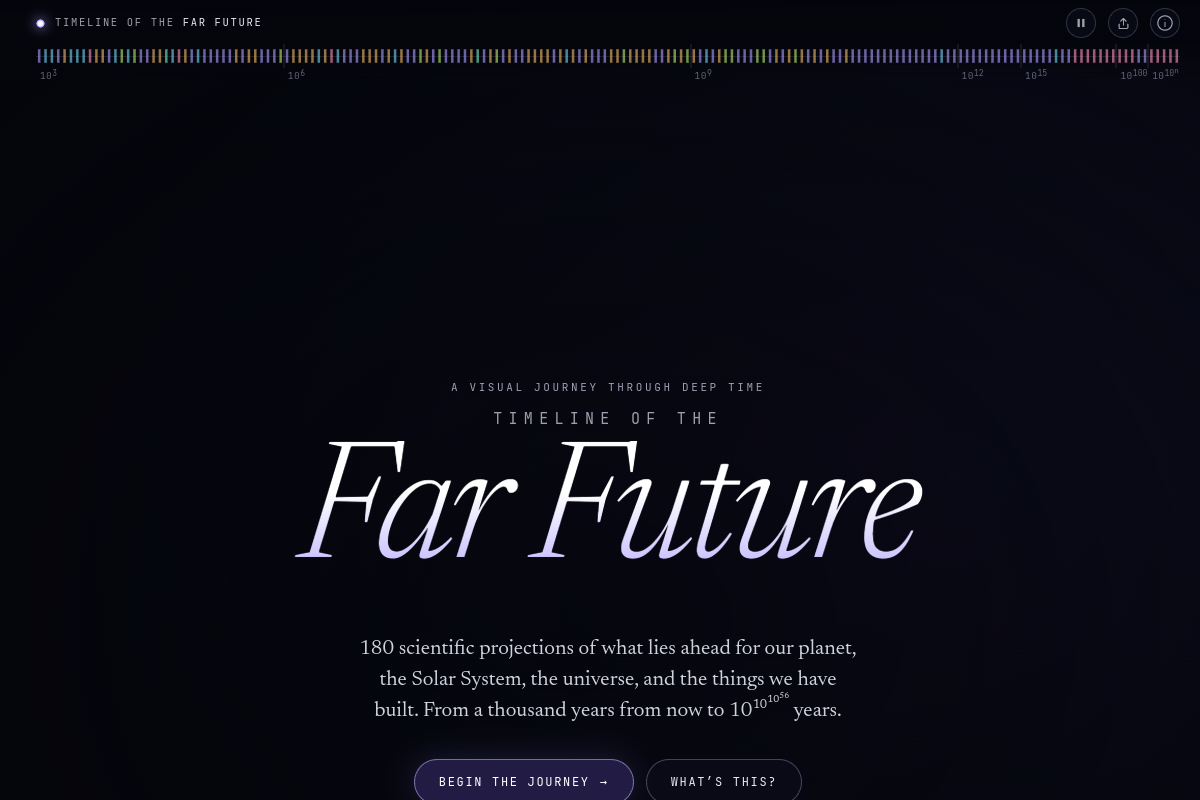
Timeline of the Far Future is a web‑based visualization engine that ingests structured Wikipedia data via the MediaWiki API and renders it as a dynamic, scrollable timeline. It addresses the challenge of making long‑term historical narratives accessible by converting raw encyclopedic entries into an interactive, time‑based narrative layer, positioning itself as a lightweight, research‑oriented data‑visualization tool.
The core workflow begins with automated data extraction from Wikipedia’s category and infobox structures, followed by a client‑side rendering pipeline built on D3.js and WebGL for smooth zooming and panning. Users can filter by time range, topic, or geographic region, and hover over nodes to reveal tooltips with article excerpts, images, and links. The tool supports export to SVG/PNG and can be embedded via an iframe or API endpoint.
Designed for academics, educators, and history enthusiasts, the platform delivers measurable ROI by reducing research time—users can locate and compare events across centuries in seconds rather than hours of manual lookup. It scales from individual students to small research teams, with no server‑side maintenance required beyond the static hosting of the web app.
Timeline of the Far Future is a web application that pulls structured data from Wikipedia via the MediaWiki API and renders it as an interactive, scrollable timeline using D3.js and WebGL. Users can explore historical events across centuries by zooming, panning, and hovering over nodes to view article summaries and images.
The tool is free to use with no trial period. All features are available at no cost.