Sonia. Local Voice Assistant Linux. ...
8.9 / 10 BenchmarkLocal LLM voice assistant with full-duplex audio, tool-calling, and no GPU requirement.

Local LLM voice assistant with full-duplex audio, tool-calling, and no GPU requirement.
| Pricing Model | Open_source |
|---|---|
| Starting Price | Free |
| Free Trial | Open Source / Self-Hosted |
| Official Pricing Tiers | View Complete Pricing Plans → |
| Ideal Audience & Best For | Linux Power Users, Privacy-Focused Developers, Homelab Enthusiasts, System Administrators |
| API & Integrations | REST API & Webhooks Ready |
| Community Upvotes | ▲ 30 votes by verified community members |
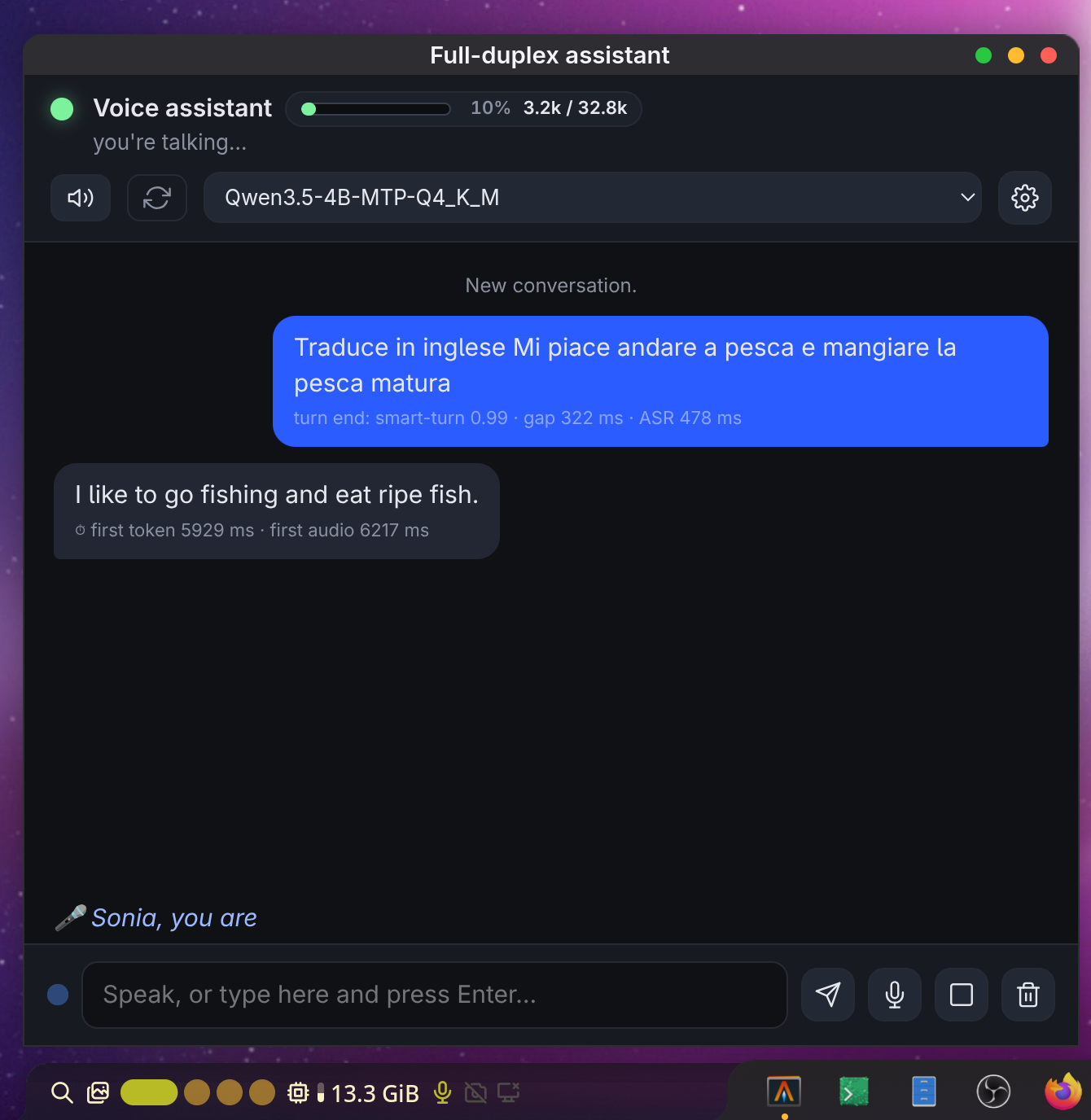
Sonia is a privacy-first, local Large Language Model (LLM) voice assistant engineered to operate entirely on consumer-grade Linux hardware without a dedicated GPU. By leveraging quantized 4B parameter models and efficient memory management, it maintains a footprint under 15 GB of RAM, solving the critical problem of high-resource dependency in local AI inference. Its architecture prioritizes low-latency, real-time interaction over cloud-dependent processing, positioning it as a robust, offline-capable alternative to commercial voice assistants that often feel rigid and monologic.
The core operational workflow is defined by its full-duplex audio engine, which keeps the microphone active during speech output, allowing users to interrupt the assistant mid-sentence. Sonia employs a sophisticated, layered turn-detection system combining Silero VAD, Smart Turn classifiers, and a 4-token LLM prompt to distinguish between genuine interruptions and background noise or backchannels. It supports function-calling for timers, notes, and shell commands, protected by a 'tool gate' judge model that validates proposed actions against user intent to prevent hallucinated tool executions. Additionally, it integrates with existing skill ecosystems via SKILL.md packages, enabling extensibility without proprietary lock-in.
Sonia is best suited for Linux power users, privacy-conscious developers, and homelab enthusiasts who require a responsive, interruptible voice interface for system administration and personal automation. It offers significant ROI by eliminating cloud API costs and data privacy risks while providing a natural, conversational experience that reduces friction in voice-driven workflows. Ideal for individual developers and small technical teams seeking a self-hosted, low-resource AI companion that can execute local commands and manage tasks with high reliability.
Sonia is a local LLM voice assistant that runs entirely on your machine using quantized models. It features a full-duplex audio engine that keeps the microphone open while speaking, allowing you to interrupt it. It uses a layered turn-detection system to distinguish real interruptions from noise and supports tool-calling for system commands, all without requiring a dedicated GPU.
Sonia is an open-source project, meaning it is free to download, install, and use. There are no subscription fees or API costs, as all processing happens locally on your hardware. You only incur the cost of the electricity and hardware required to run it.
Sonia is ideal for Linux power users, developers, and privacy-conscious individuals who want a responsive, interruptible voice assistant that can execute local commands. It is particularly well-suited for those who have standard CPU-based hardware and wish to avoid cloud dependencies for their AI interactions.
Sonia is designed for Linux platforms and integrates with local shell commands for system administration. It supports modular skill integration via SKILL.md packages, allowing it to work with existing agent ecosystems like pi or opencode. It does not rely on cloud APIs, ensuring all data remains local.