Reflex
8.9 / 10 BenchmarkInstant AI‑powered workspaces that spin up on demand

Instant AI‑powered workspaces that spin up on demand
| Pricing Model | Free |
|---|---|
| Starting Price | Free |
| Free Trial | None |
| Official Pricing Tiers | View Complete Pricing Plans → |
| Ideal Audience & Best For | Data Scientists, Prompt Engineers, ML Ops Teams, AI Startups |
| API & Integrations | REST API & Webhooks Ready |
| Community Upvotes | ▲ 24 votes by verified community members |
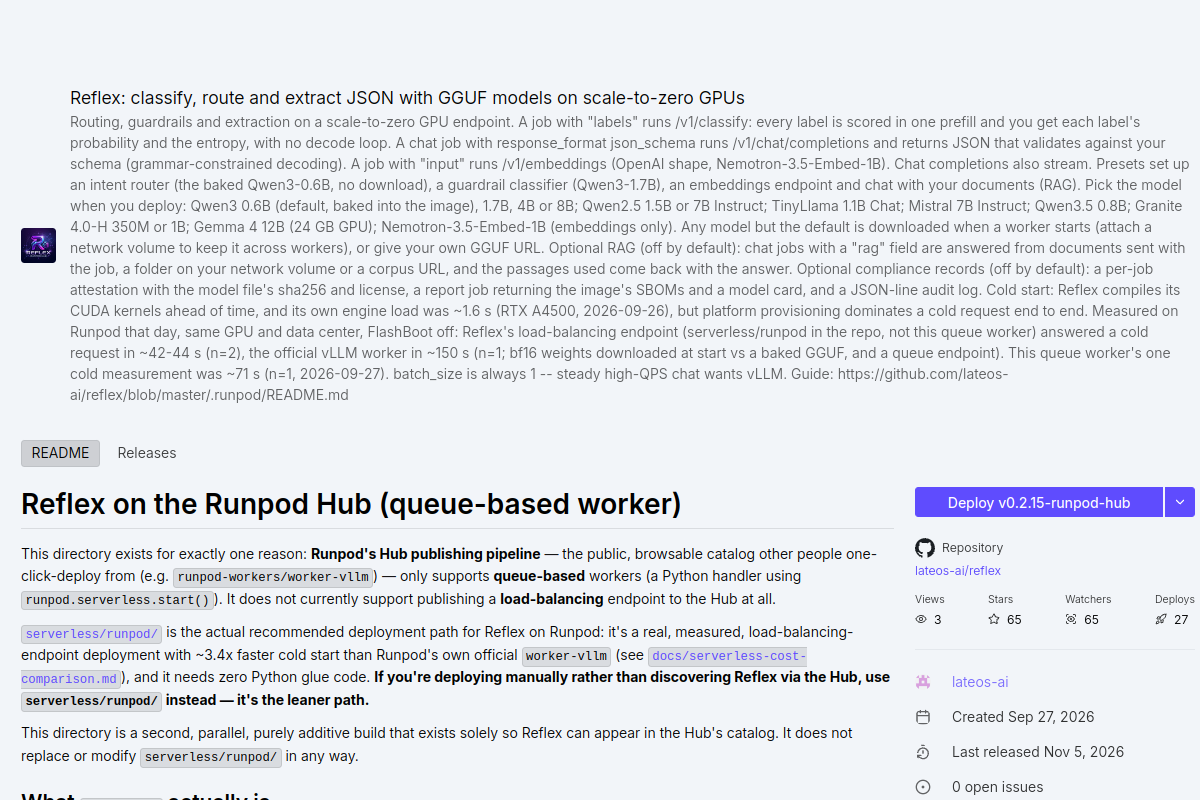
Reflex runs on RunPod’s GPU‑backed cloud, exposing a containerized micro‑service architecture that provisions isolated Jupyter‑style environments in seconds. It solves the friction of local hardware constraints and complex dependency management for AI teams, positioning itself as a plug‑and‑play development hub for data scientists, prompt engineers, and LLM‑ops.
Users launch a workspace via a web UI or API, select a pre‑built stack (Python, PyTorch, TensorFlow, LangChain, etc.), and immediately gain access to GPU, storage, and secure networking. The platform supports notebook, terminal, and VS Code‑Web interfaces, while exposing REST endpoints for programmatic control. Integrated model hubs (OpenAI, Anthropic, Cohere) let you run inference directly inside the workspace, and built‑in versioning syncs code and data across teams.
Ideal for AI startups, research labs, and enterprise ML Ops squads, Reflex cuts environment‑setup time by up to 90 %, enabling teams of 3‑50 engineers to iterate faster and reduce cloud‑cost overruns. Measurable ROI includes faster prototype cycles, lower DevOps overhead, and predictable budgeting through per‑hour usage tracking.
Reflex is a cloud‑native workspace platform that provisions isolated, GPU‑enabled containers on RunPod. Users select a pre‑configured AI stack, launch the environment via a web UI or API, and instantly gain access to notebooks, terminals, and model APIs for development and inference.
Reflex is offered as a free tier with no charge for basic workspace usage. There is no separate trial period; you can start using the platform immediately and only pay for additional GPU hours beyond the free allocation, if any.
Reflex is ideal for data scientists, prompt engineers, ML‑Ops engineers, and AI startups that need fast, scalable GPU environments without managing hardware or complex DevOps pipelines.
Reflex integrates with major LLM providers (OpenAI, Anthropic, Cohere), supports Python libraries (PyTorch, TensorFlow, LangChain), and offers access via a web app, REST API, Docker images, and a command‑line interface for CI/CD automation.