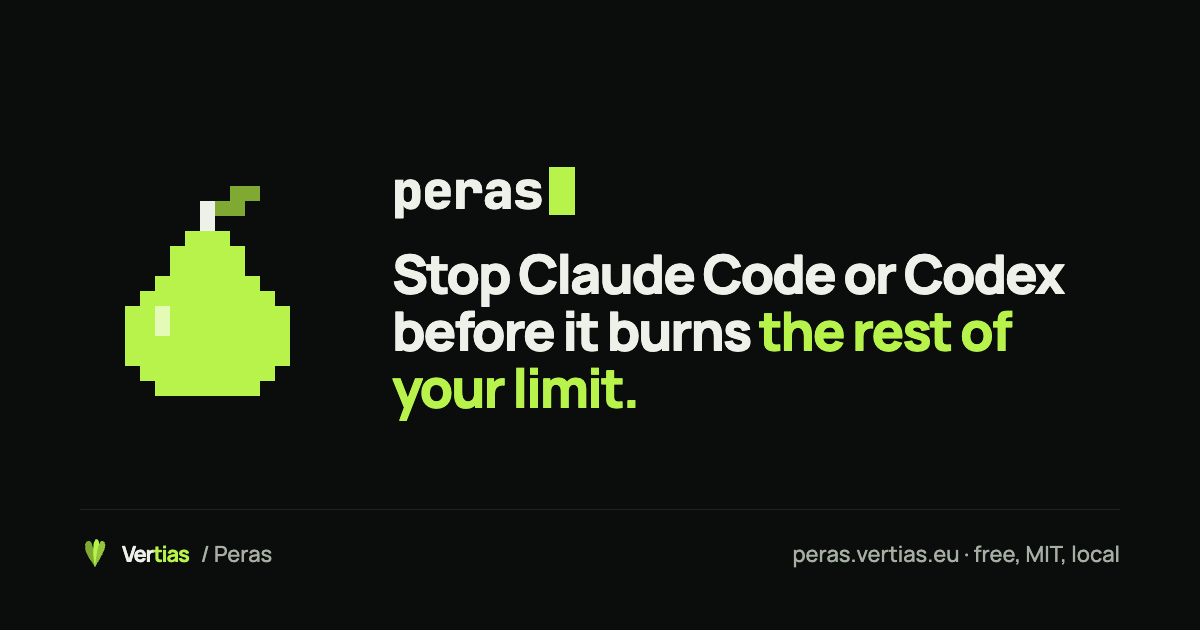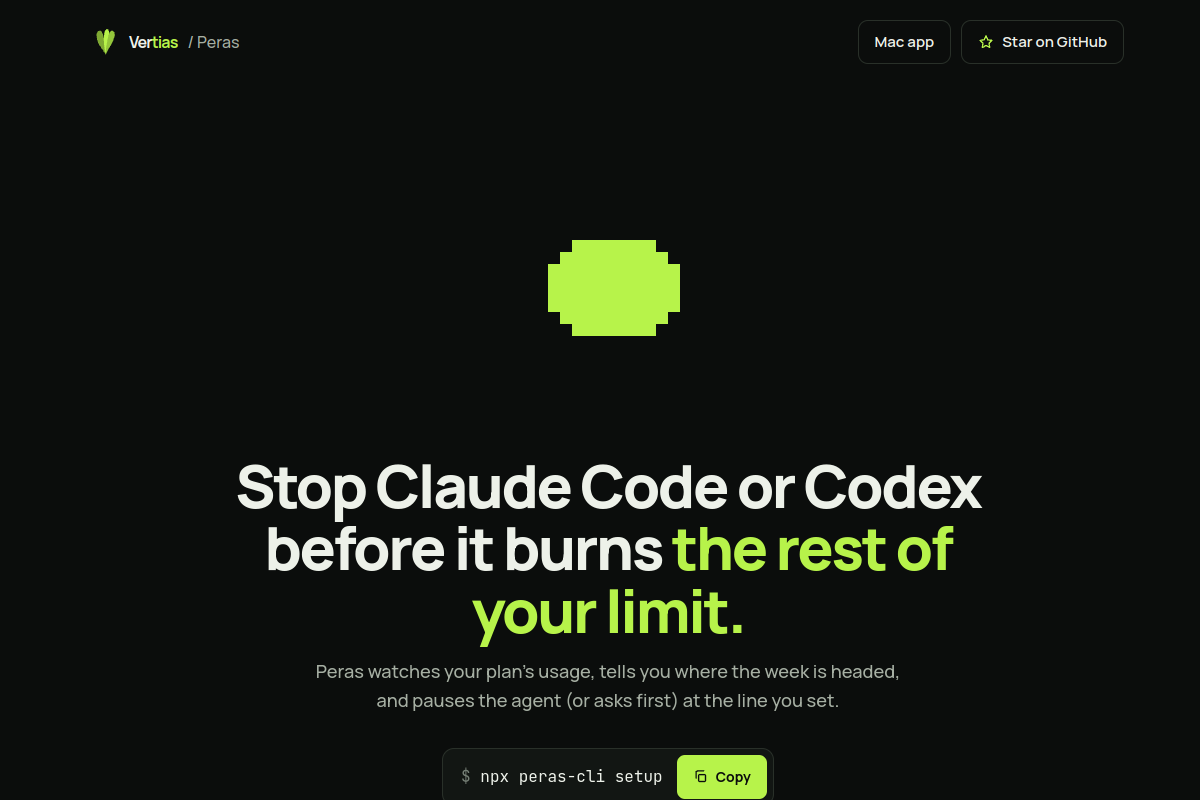
Interface & Product Gallery

Product Specifications

Pricing Model Freemium
Starting Price Free (CLI) / €4.99 (App)
Free Trial Free Tier Available
Official Pricing Tiers View Complete Pricing Plans →
Ideal Audience & Best For AI Engineers, Senior Developers, Technical Founders, DevOps Engineers
API & Integrations REST API & Webhooks Ready
Community Upvotes ▲ 27 votes by verified community members

Core Capabilities & Features

Real-Time Usage Monitoring: Tracks 5-hour and 7-day usage windows for Claude Code and Codex, displaying current percentage and projected reset times with high precision.
Granular Pause Mechanisms: Offers three distinct intervention levels—warn, ask, and pause—allowing users to choose between passive notifications, interactive approvals, or hard stops on agent execution.
Context-Aware Budgeting: Supports per-folder weekly allowances and daily caps, enabling developers to allocate specific token budgets to individual projects or codebases.
Time-Based Scheduling: Implements time-window specific limits (e.g., 50% cap during overnight hours) to prevent background agents from consuming excessive resources during off-peak times.
Native macOS Menu Bar App: Provides a lightweight, always-on visual indicator with one-click pause/resume controls and detailed weekly charts, accessible via global hotkeys.
Dual-Agent Support: Simultaneously monitors and controls both Claude Code and OpenAI Codex, keeping their usage histories, limits, and pause states strictly separated.
Local-First Privacy: Operates entirely on the local machine using MIT-licensed code, ensuring no usage data is sent to third-party servers and maintaining full user control over agent behavior.

About Peras

Peras is a local-first, open-source utility designed to solve the critical problem of uncontrolled token consumption in autonomous AI coding agents like Claude Code and OpenAI Codex. By intercepting agent activity at the local level, it provides real-time visibility into usage against subscription-based limits (Claude Pro/Max, ChatGPT), preventing costly overages or forced throttling. It positions itself as an essential operational safety layer for developers relying on high-volume LLM interactions, ensuring that automated workflows respect predefined budgetary constraints without requiring cloud-based telemetry or external API keys.

The tool operates through a combination of a lightweight CLI and an optional native macOS menu bar application. It monitors usage percentages in real-time, offering granular control mechanisms such as 'warn' (notification only), 'ask' (requires user approval for the next tool call), and 'pause' (hard stop on tool execution). Peras supports complex scheduling rules, including daily allowances, per-folder budgets, time-based restrictions (e.g., overnight caps), and pace-based limits. It integrates directly with the local file system and agent hooks, allowing users to visualize usage trends, review historical sessions, and manage multiple agent profiles simultaneously from a single interface.

Peras is ideal for professional developers, AI engineers, and technical founders who utilize subscription-based AI coding assistants for heavy-duty automation. By preventing limit exhaustion, it ensures uninterrupted workflow continuity and protects against the operational downtime caused by hitting usage caps. The tool is particularly valuable for teams or individuals running parallel agent sessions, as it allows for precise allocation of resources across different projects or time zones, maximizing the ROI of expensive AI subscriptions while maintaining full local data privacy.

Top Alternatives to Peras

View all in category →

Turn AI‑generated code bugs into a competitive learning game

▲ 95 upvotes Compare →

Instant AI‑powered domain ideas with live registration checks, all on your device

▲ 94 upvotes Compare →

Free collaborative canvas where humans and AI co‑create UI mockups in real time

▲ 92 upvotes Compare →

Identify the hidden model behind any LLM output in seconds

▲ 91 upvotes Compare →

Verified User Reviews

0 community review(s)
No user reviews posted yet. Be the first to share your experience with Peras!

Editorial Pros & Cons

Key Advantages (Pros)

  • Prevents costly overages and workflow interruptions by enforcing hard stops on agent activity before limits are reached.
  • Fully local and open-source (MIT), ensuring zero data leakage and complete transparency in how usage is calculated.
  • Highly granular control allows for complex budgeting strategies, such as per-project caps and time-based restrictions.
  • Lightweight native macOS app provides instant visual feedback and control without requiring a full IDE or browser context.

Considerations (Cons)

  • The native menu bar application is a one-time paid purchase (€4.99), while the core CLI remains free, creating a slight fragmentation in the user experience.
  • Currently optimized for macOS; Linux and Windows users must rely solely on the CLI or build the app from source, lacking a native GUI.

Supported Platforms & Integrations

macOS CLI Terminal

Frequently Asked Questions

What is Peras and how does it work?

Peras is a local utility that monitors the usage limits of AI coding agents like Claude Code and Codex. It reads local usage data and enforces user-defined limits by pausing, warning, or asking for approval when an agent approaches its threshold, preventing limit exhaustion.

How much does Peras cost and is there a free trial?

The core CLI and guard functionality are completely free and open-source under the MIT license. The optional native macOS menu bar application is available for a one-time purchase of €4.99. There is no subscription fee.

Who is Peras best suited for?

Peras is best suited for developers and engineers who use subscription-based AI coding tools (Claude Pro/Max, ChatGPT) for heavy, automated, or long-running tasks and need to ensure they do not hit usage caps prematurely.

What integrations and platforms does Peras support?

Peras integrates directly with Claude Code and OpenAI Codex via local hooks. It runs on macOS (with a native app option) and is available as a CLI tool for any Unix-like environment. It does not require cloud API keys or external server integrations.