Modula-9, a Wirth-family language de...
8.9 / 10 BenchmarkA Wirth-family language with Rust-level safety and C-level performance for critical code.

A Wirth-family language with Rust-level safety and C-level performance for critical code.
| Pricing Model | Open_source |
|---|---|
| Starting Price | Free |
| Free Trial | Free Open Source |
| Official Pricing Tiers | View Complete Pricing Plans → |
| Ideal Audience & Best For | Systems Engineers, Scientific Researchers, Safety-Critical Software Developers, Financial Systems Architects |
| API & Integrations | REST API & Webhooks Ready |
| Community Upvotes | ▲ 17 votes by verified community members |
Modula-9 (M9) is a modern systems programming language rooted in the Wirth family (Pascal/Modula), engineered specifically for high-integrity environments where code correctness is non-negotiable. It positions itself as a bridge between the readability of traditional structured languages and the rigorous safety guarantees of Rust, targeting domains like scientific computing, financial systems, and embedded software. The architecture is built on the principle that every language rule exists to prevent a specific, historically documented bug, ensuring that the compiler actively refuses unsafe patterns rather than allowing them to execute silently.
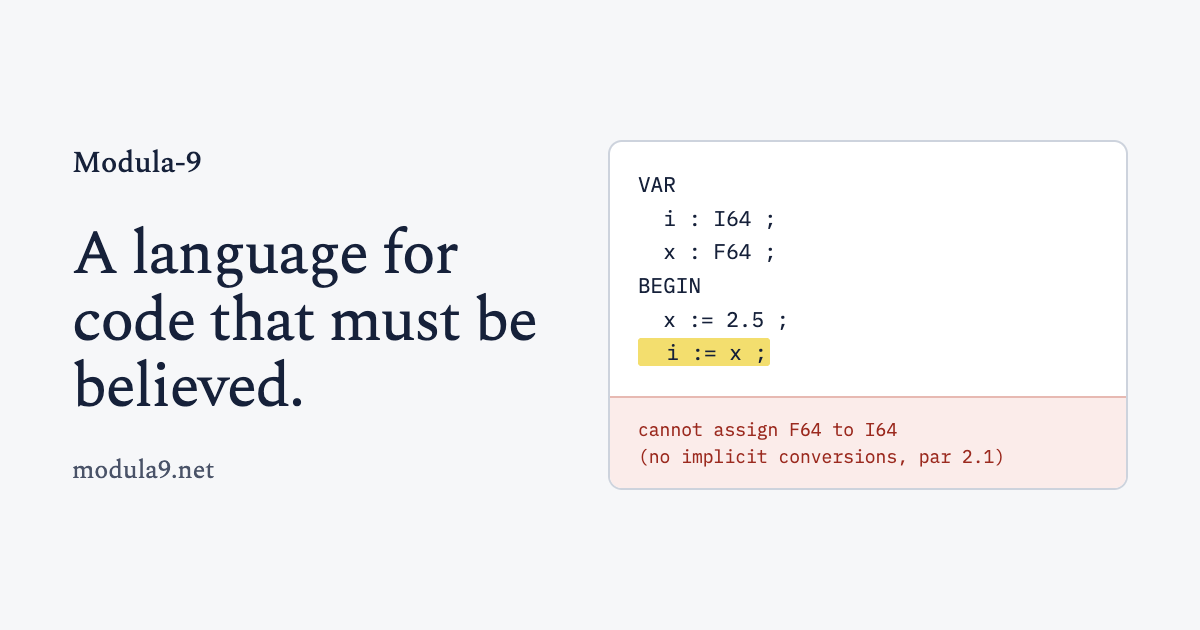
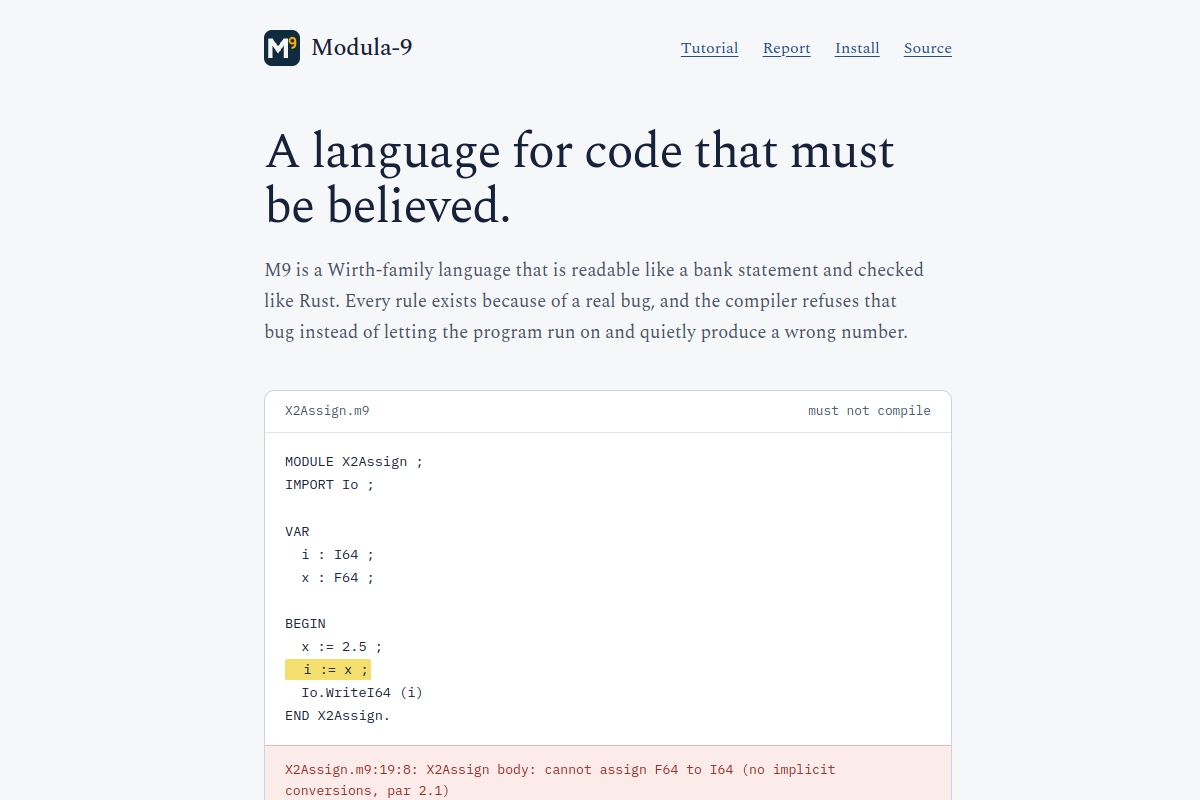
The core workflow emphasizes explicitness and verifiability. M9 features strict type systems where numeric types explicitly name their width (e.g., I64, F64) and prohibit implicit conversions, preventing subtle data corruption. It includes mandatory runtime checks that cannot be disabled, ensuring memory and logic safety at the cost of only ~3% performance overhead. The toolchain is comprehensive, including a self-hosting compiler that produces byte-identical output, a VS Code extension with a language server, a Jupyter kernel for interactive data science, and a browser-based playground. The language supports advanced features like threads, zarr/NetCDF file reading, and statistical regressions, with a tutorial that guides users from basics to complex data analysis tasks.
Modula-9 is best suited for senior engineers, scientific researchers, and safety-critical software teams who require provable correctness without sacrificing performance. It offers significant ROI by eliminating entire classes of runtime errors and data corruption bugs, reducing debugging time and increasing confidence in production code. The open-source nature (GPLv3 compiler with a runtime exception allowing proprietary linking) makes it accessible for both academic and commercial use, ideal for teams building critical infrastructure, financial algorithms, or scientific simulations where a single silent bug can have catastrophic consequences.
Modula-9 (M9) is a Wirth-family programming language designed for code that must be believed. It combines the readability of Pascal/Modula with the safety guarantees of Rust. It works by enforcing strict type systems, prohibiting implicit conversions, and including mandatory runtime checks that cannot be disabled. The compiler is self-hosting and produces deterministic, byte-identical output.
Modula-9 is free and open source. The compiler is licensed under GPLv3, and the runtime and standard library include a runtime exception that allows you to link M9 code into proprietary applications. There are no costs or trials required; you can download and use it immediately.
Modula-9 is best suited for developers working on safety-critical systems, scientific computing, financial applications, or any domain where data integrity and bug prevention are paramount. It is ideal for teams who need high performance (comparable to C) but require the safety guarantees of a more modern language.
Modula-9 supports Linux (Ubuntu, Debian, Fedora, Rocky, Arch), macOS (Apple Silicon, experimental), and Windows (experimental). It integrates with VS Code via an extension and language server, and includes a Jupyter kernel for interactive data science. It also provides a browser-based playground for quick testing.