MediationBench
8.5 / 10 BenchmarkBenchmarking AI mediators across 62 simulated conflicts to evaluate negotiation efficacy.

Benchmarking AI mediators across 62 simulated conflicts to evaluate negotiation efficacy.
| Pricing Model | Free |
|---|---|
| Starting Price | Free |
| Free Trial | Free Access |
| Official Pricing Tiers | View Complete Pricing Plans → |
| Ideal Audience & Best For | AI Researchers, Safety Engineers, LLM Developers, Policy Makers |
| API & Integrations | REST API & Webhooks Ready |
| Community Upvotes | ▲ 24 votes by verified community members |
MediationBench is a specialized evaluation framework designed to audit the performance of Large Language Models (LLMs) acting as mediators in synthetic conflict scenarios. The platform addresses the critical gap in assessing AI's ability to facilitate dispute resolution by creating a controlled environment where language models play both disputing parties, while the system under test assumes the role of the mediator. This architecture allows for rigorous, reproducible testing of mediation strategies without the variability and ethical complexities inherent in human interactions, positioning MediationBench as a foundational tool for AI safety and alignment research in social domains.
The core workflow involves executing 62 authored disputes, ranging from business breakups to personal conflicts, within a fixed 3-to-25-round interaction window. The mediator model must dynamically decide whether to speak, wait, or end the conversation after each message. Upon completion, an independent AI judge, referred to as 'Sol,' evaluates the transcript based on five specific criteria, assigning a score out of 100. The system supports multiple judges, with scores averaged only when a judge has evaluated all 62 conflicts, ensuring that early results are labeled as provisional to maintain data integrity and prevent premature conclusions.
MediationBench is primarily targeted at AI researchers, safety engineers, and policy makers interested in the deployment of AI in conflict resolution and customer service roles. By providing standardized metrics for mediation quality, it helps organizations quantify the operational readiness of AI mediators before real-world deployment. While it does not measure human safety or legal validity, it offers a crucial baseline for understanding how different models handle persuasion, de-escalation, and agreement formation, saving significant time in the iterative development and testing of conversational AI agents.
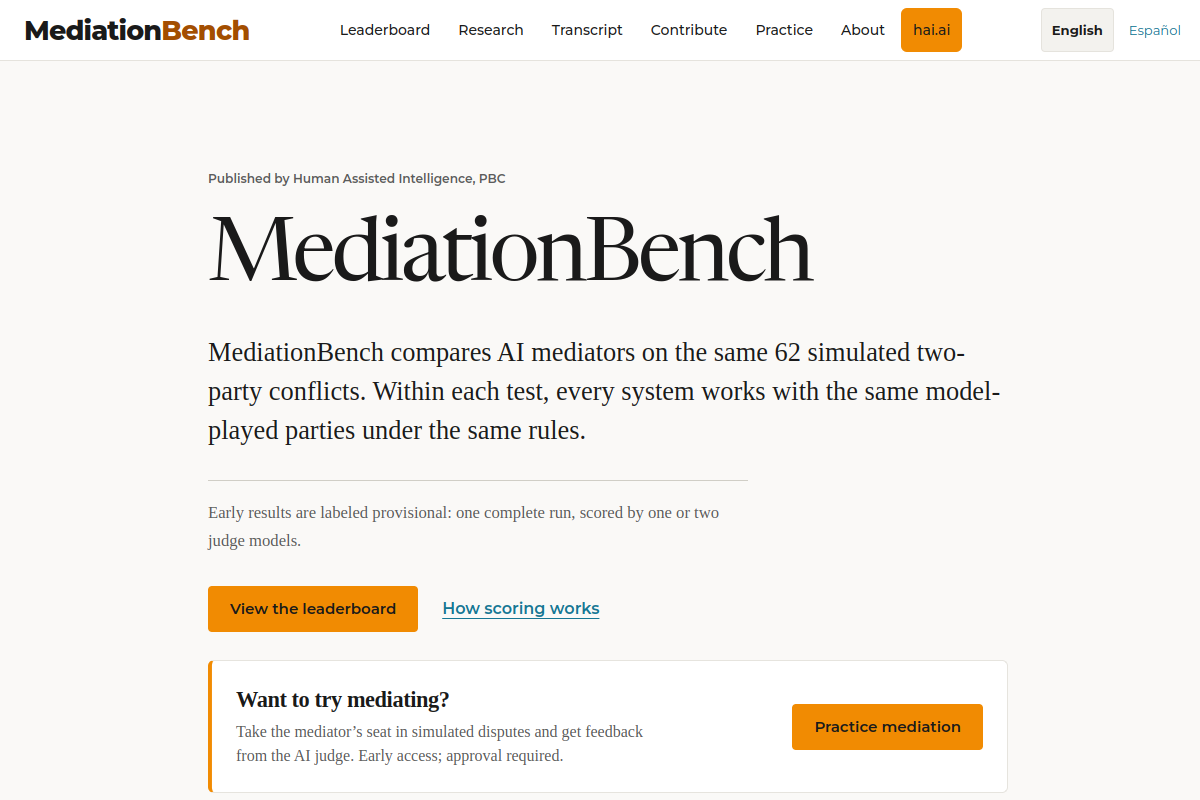
MediationBench is a testing platform that evaluates AI mediators in simulated conflicts. It uses 62 authored disputes where LLMs play both parties, and the system under test acts as the mediator. The mediator decides when to speak, wait, or end the conversation, and an AI judge scores the final transcript out of 100.
MediationBench is a free research tool. There is no separate pricing page, and access to the benchmark results, methodology, and data is available directly through the website.
It is best suited for AI researchers, safety engineers, and developers working on LLMs who need to evaluate the performance of their models in mediation and conflict resolution tasks before deploying them in real-world applications.
MediationBench is primarily a web-based research platform. It provides access to benchmark results, a working draft paper, and downloadable data. It does not offer API integrations for direct model testing but serves as a reference standard for evaluation.