An Open Source Aircraft
8.9 / 10 BenchmarkOpen-source parametric aircraft design with real-time structural, cost, and performance analysis.

Open-source parametric aircraft design with real-time structural, cost, and performance analysis.
| Pricing Model | Open_source |
|---|---|
| Starting Price | Free |
| Free Trial | Free Open Source |
| Official Pricing Tiers | View Complete Pricing Plans → |
| Ideal Audience & Best For | Amateur Aircraft Builders, Aerospace Engineering Students, Independent Avionics Engineers |
| API & Integrations | REST API & Webhooks Ready |
| Community Upvotes | ▲ 13 votes by verified community members |
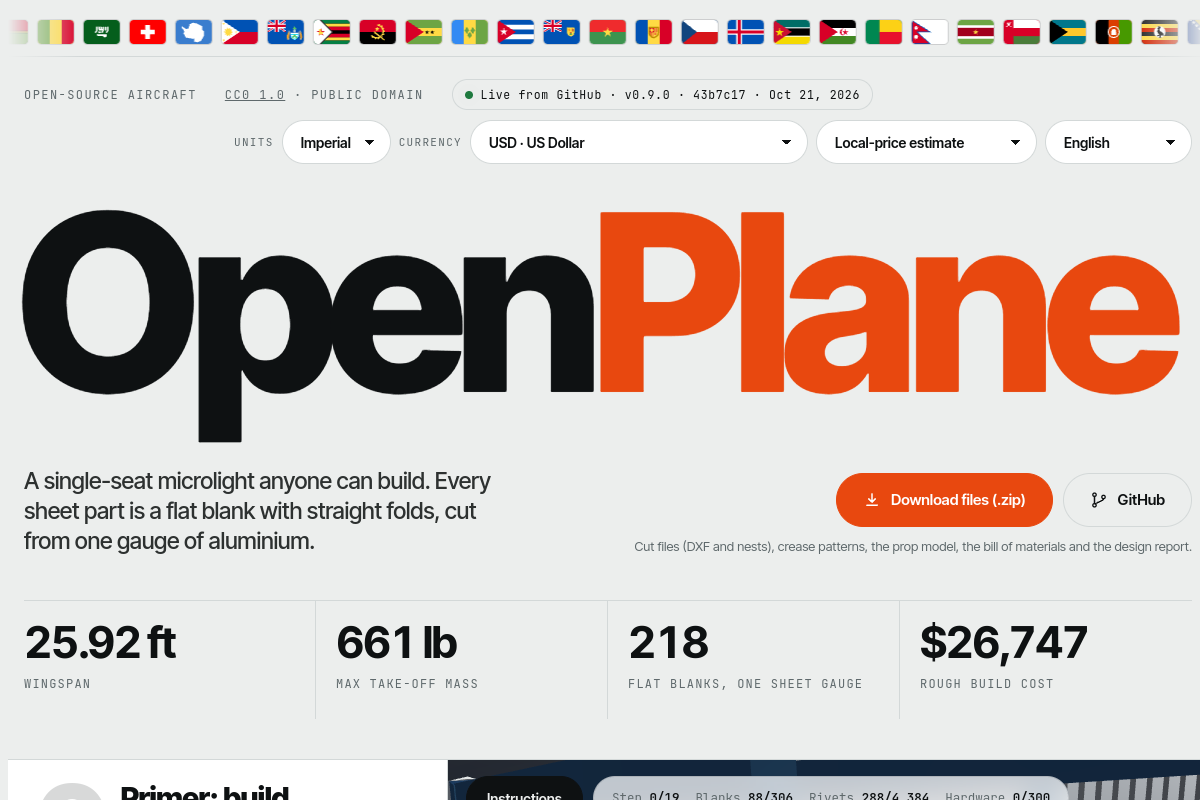
OpenPlane is an open-source, web-based engineering platform that democratizes aircraft design by providing a parametric 3D model of a light aircraft. It solves the high barrier to entry in aerospace engineering by integrating geometric definition, structural analysis, and cost estimation into a single, transparent workflow. The tool positions itself as a rigorous yet accessible sandbox for builders and engineers, utilizing beam theory for initial stress calculations and DXF-based flat patterns for manufacturing readiness.
The core workflow involves manipulating a 19-step assembly process where users can inspect blanks, rivets, and hardware in a 3D hangar environment. Key capabilities include real-time 'X-ray' visualization of internal structures, stress mapping under +4g/-2g loads with a 1.5x ultimate load factor, and a dynamic Bill of Materials (BOM) that calculates local pricing based on exchange rates and tax jurisdictions. The system outputs precise DXF files for laser cutting or CNC, alongside CSV exports for procurement, and provides performance metrics such as endurance, range, and center of gravity (CG) stability margins.
OpenPlane is best suited for advanced hobbyist builders, aerospace students, and independent engineers seeking to prototype light aircraft without proprietary software licenses. It offers significant ROI by reducing design iteration time through immediate feedback on structural margins and material costs. While it serves individual builders and small teams, its transparency allows for rigorous peer review and educational use, saving months of manual calculation and spreadsheet management typically required in amateur aviation projects.
OpenPlane is an open-source web application that provides a parametric 3D model of a light aircraft. It works by allowing users to manipulate the assembly steps, view real-time structural stress calculations based on beam theory, and generate manufacturing-ready DXF files for each component.
OpenPlane is completely free and open-source. There are no subscription fees or trial periods; users can access the full tool, download all data files, and use the design for personal or educational purposes without cost.
It is best suited for amateur aircraft builders, aerospace engineering students, and independent engineers who want to design, analyze, and build a light aircraft with a rigorous, transparent, and cost-effective workflow.
OpenPlane runs as a web application and supports exporting Bill of Materials data via CSV and manufacturing files via DXF. It does not currently list native integrations with external CAD or FEA software, but its open data format allows for manual import into other tools.