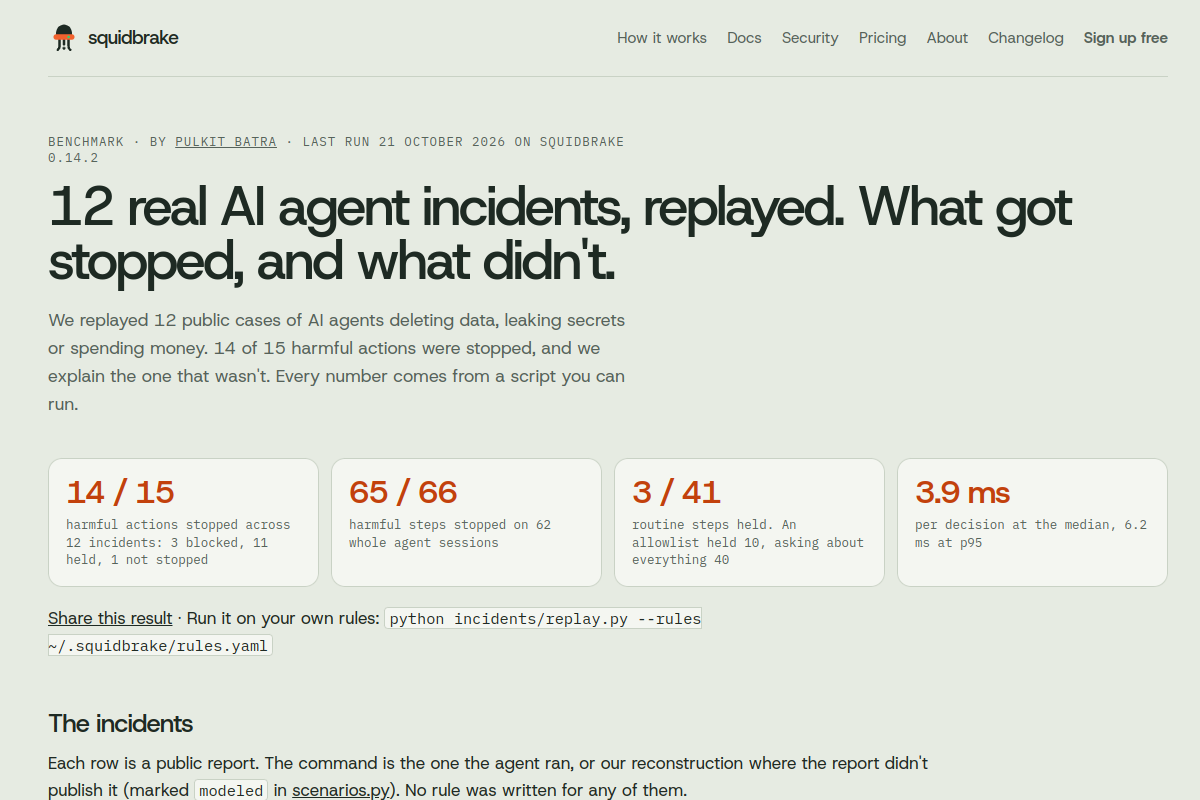
We replayed 12 real AI agent inciden...
9.0 / 10 BenchmarkReal‑time guardrails that stop rogue AI agents before they damage your data or spend money
Real‑time guardrails that stop rogue AI agents before they damage your data or spend money
| Pricing Model | Freemium |
|---|---|
| Starting Price | Free |
| Free Trial | 14-Day Free Trial |
| Official Pricing Tiers | View Complete Pricing Plans → |
| Ideal Audience & Best For | DevOps Engineers, Cloud Security Teams, AI Product Managers, Compliance Officers |
| API & Integrations | REST API & Webhooks Ready |
| Community Upvotes | ▲ 48 votes by verified community members |
Squidbrake is a lightweight, on‑premise guardrail engine built on SQLite and a fast rule‑evaluation engine (<7 ms median latency). It tackles the emerging problem of autonomous AI agents executing destructive commands by intercepting every action and applying policy rules before the command reaches the target system. Positioned as a security‑first layer for any AI‑augmented workflow, it runs in Docker, on a laptop, or on any server you control, keeping all agent activity local.
The platform ingests raw agent commands (shell, API calls, file ops) via a REST hook or direct SDK, evaluates them against a configurable rule set (block, hold, allow), and returns a decision with optional human approval routes (dashboard, Slack, Teams, email, phone). It supports custom Python rule scripts, integrates with Anthropic, OpenAI, and other LLM providers for context‑aware briefings, and can export audit trails in CSV/JSON for compliance. Rules are hash‑chained for tamper‑evidence and can be scoped per agent, session, or organization.
Squidbrake is designed for DevOps, security engineers, compliance officers, and AI product teams that run autonomous agents in production. By automatically halting 14 of 15 harmful steps in real‑world incident replay, it can shave hours of incident response time, reduce breach risk, and protect cloud spend. Ideal for startups to enterprises that manage multiple AI agents across cloud, CI/CD pipelines, and internal tooling.
Squidbrake is an on‑premise guardrail engine that intercepts every command an AI agent attempts to run. It evaluates the command against a set of configurable rules and returns a block, hold, or allow decision in milliseconds. Holds can be routed to human approvers via Slack, Teams, email, or phone, and all actions are logged in a tamper‑evident audit trail.
Squidbrake offers a free self‑hosted tier with unlimited rules and single‑user usage. The Team plan costs $499 per month and includes multi‑user approvals, hosted dashboard, audit export, and 14‑day free trial with no credit card required. Enterprise pricing is custom.
It is ideal for DevOps, cloud security engineers, AI product teams, and compliance officers who run autonomous agents in production and need real‑time protection against destructive or risky actions.
Squidbrake runs as a Docker container on Linux, Windows, or macOS, and can be embedded via a REST API or SDK. It integrates with Slack, Microsoft Teams, email, phone (SMS/voice), Anthropic/OpenAI for AI briefings, and connects to cloud providers (AWS, Azure, GCP) and CI/CD tools via custom connectors.