Receptive Field
9.0 / 10 BenchmarkInteractive, browser-based deep learning textbook for mastering CNNs from first principles.

Interactive, browser-based deep learning textbook for mastering CNNs from first principles.

| Pricing Model | Free |
|---|---|
| Starting Price | Free |
| Free Trial | Free Tier Available |
| Official Pricing Tiers | View Complete Pricing Plans → |
| Ideal Audience & Best For | CS Students, Junior ML Engineers, Data Scientists, Academic Researchers |
| API & Integrations | REST API & Webhooks Ready |
| Community Upvotes | ▲ 37 votes by verified community members |
Receptive Field is an open-source, interactive educational platform designed to demystify Convolutional Neural Networks (CNNs) through visual intuition rather than abstract mathematics. It addresses the common barrier to entry in deep learning by replacing static diagrams with dynamic, in-browser simulations that allow learners to manipulate kernels, strides, and padding in real-time. The platform positions itself as a rigorous yet accessible bridge between theoretical computer science and practical neural network engineering, ensuring users understand the geometric and algebraic underpinnings of feature extraction.
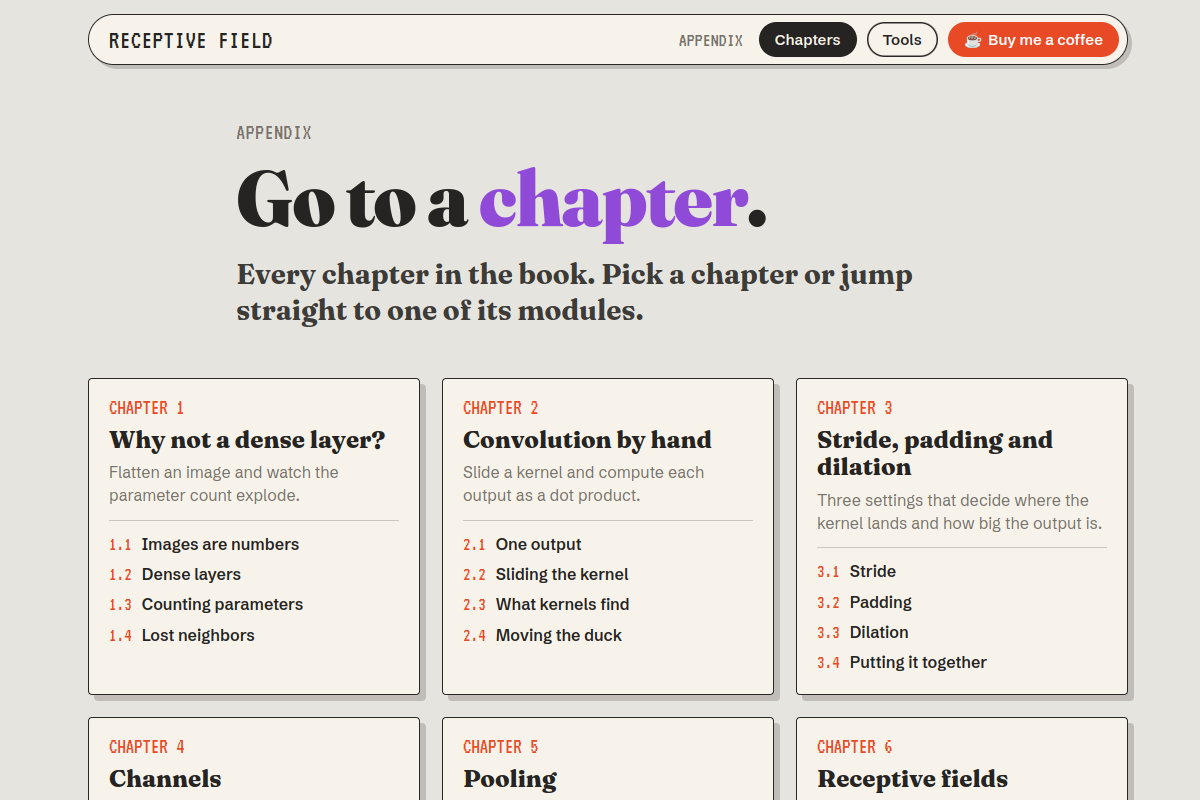
The core workflow involves a modular, chapter-based curriculum where users engage with 36 distinct interactive modules. Key capabilities include visualizing parameter explosion in dense layers, manually sliding convolution kernels to compute dot products, and observing how stride, padding, and dilation affect output dimensions. The platform features a live, in-browser CNN inference engine that allows users to inspect layer-by-layer activations, visualize receptive field growth, and trace backpropagation gradients, providing a transparent view of how networks learn and where they fail.
This tool is best suited for computer science students, junior data scientists, and ML engineers seeking to solidify their foundational understanding of CNN architectures. By providing immediate visual feedback on architectural choices, it significantly reduces the time required to debug model behavior and understand spatial hierarchies. Ideal for individual learners and academic settings, it offers high ROI in terms of conceptual clarity, enabling users to move from passive reading to active experimentation with zero setup overhead.
Receptive Field is an interactive online textbook that teaches Convolutional Neural Networks through visual simulations. It works by running lightweight neural network models directly in your web browser, allowing you to manipulate parameters like kernel size and stride to see immediate effects on image processing and feature extraction.
Receptive Field is completely free to read and use. There is no subscription or paywall. The creators offer an optional 'Buy me a coffee' link to support the maintenance of the free resource, but no payment is required to access any of the 36 modules.
It is ideal for computer science students, junior data scientists, and ML engineers who have some basic programming knowledge but struggle with the spatial and mathematical concepts of CNNs. It is particularly useful for those who learn better through visual and interactive methods than through static text or equations.
Receptive Field is a standalone web application that runs in any modern browser (Chrome, Firefox, Safari, Edge). It does not require external integrations, APIs, or local software installations, as all computational processing is handled client-side via JavaScript/WebAssembly.