Marcus
9.0 / 10 BenchmarkOpen-source verification layer that forces AI agents to prove their citations and outputs.
Open-source verification layer that forces AI agents to prove their citations and outputs.

| Pricing Model | Open_source |
|---|---|
| Starting Price | Free |
| Free Trial | Open Source |
| Official Pricing Tiers | View Complete Pricing Plans → |
| Ideal Audience & Best For | Researchers, Fact-Checkers, Legal Teams, AI Developers, Compliance Officers |
| API & Integrations | REST API & Webhooks Ready |
| Community Upvotes | ▲ 27 votes by verified community members |
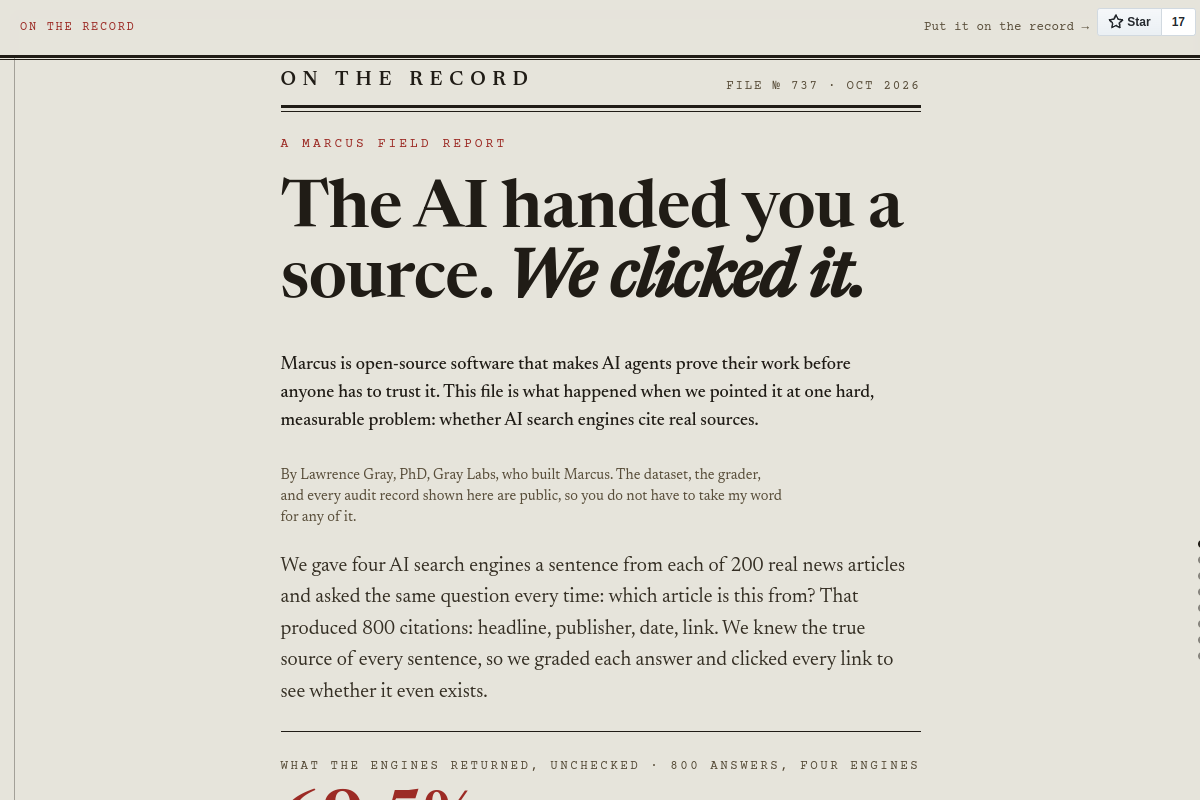
Marcus is an open-source software framework designed to solve the critical trust deficit in AI-generated content by implementing a deterministic verification layer. It positions itself as an audit mechanism for AI agents, ensuring that any claim, citation, or data point provided by an LLM is validated against ground truth before being accepted. The architecture operates independently of the generative model, using rule-based checks to verify the existence, accuracy, and relevance of external references, thereby transforming opaque AI outputs into verifiable, auditable records.
The core workflow involves intercepting AI outputs, such as search engine citations or factual claims, and subjecting them to a series of deterministic tests. For example, Marcus checks if cited URLs resolve, if the specific excerpt appears on the linked page, if the domain matches the named publisher, and if the content is original rather than a reprint. It supports inputs from various AI search engines and LLMs, processing structured outputs like headlines, dates, and links. The system generates a public audit record for each check, providing a transparent trail of verification that can be inspected by users or automated systems.
Marcus is best suited for researchers, fact-checkers, legal professionals, and developers building AI applications where hallucination is unacceptable. It provides operational ROI by eliminating the need for manual spot-checking of AI citations, saving significant time in verification workflows. Ideal for teams ranging from individual researchers to enterprise compliance departments, it ensures that AI-driven insights are backed by verifiable evidence, reducing the risk of acting on fabricated or dead sources.
Marcus is an open-source software tool that verifies AI-generated outputs, particularly citations. It works by taking AI-provided sources (links, headlines, dates) and running them through a series of deterministic checks, such as verifying if the link exists, if the content matches the excerpt, and if the domain is correct. It then generates a public audit record of these checks.
Marcus is open-source software, meaning it is free to use and inspect. There is no subscription fee or trial period; users can clone the repository and deploy it according to their needs.
Marcus is ideal for researchers, journalists, legal professionals, and developers who rely on AI for information retrieval but need to ensure the accuracy and verifiability of the sources provided. It is particularly useful for teams that require an audit trail for AI-generated content.
Marcus is model-agnostic and can integrate with any AI system that outputs structured citations. It is primarily a web-based or CLI tool that can be self-hosted, and it supports standard web protocols for fetching and verifying URLs.