Llms.py
9.1 / 10 BenchmarkAll your LLMs, one lightweight gateway.

All your LLMs, one lightweight gateway.
| Pricing Model | Open_source |
|---|---|
| Starting Price | Free |
| Free Trial | None |
| Official Pricing Tiers | View Complete Pricing Plans → |
| Ideal Audience & Best For | Developers, Data Scientists, Product Teams, Open Source Enthusiasts |
| API & Integrations | REST API & Webhooks Ready |
| Community Upvotes | ▲ 42 votes by verified community members |
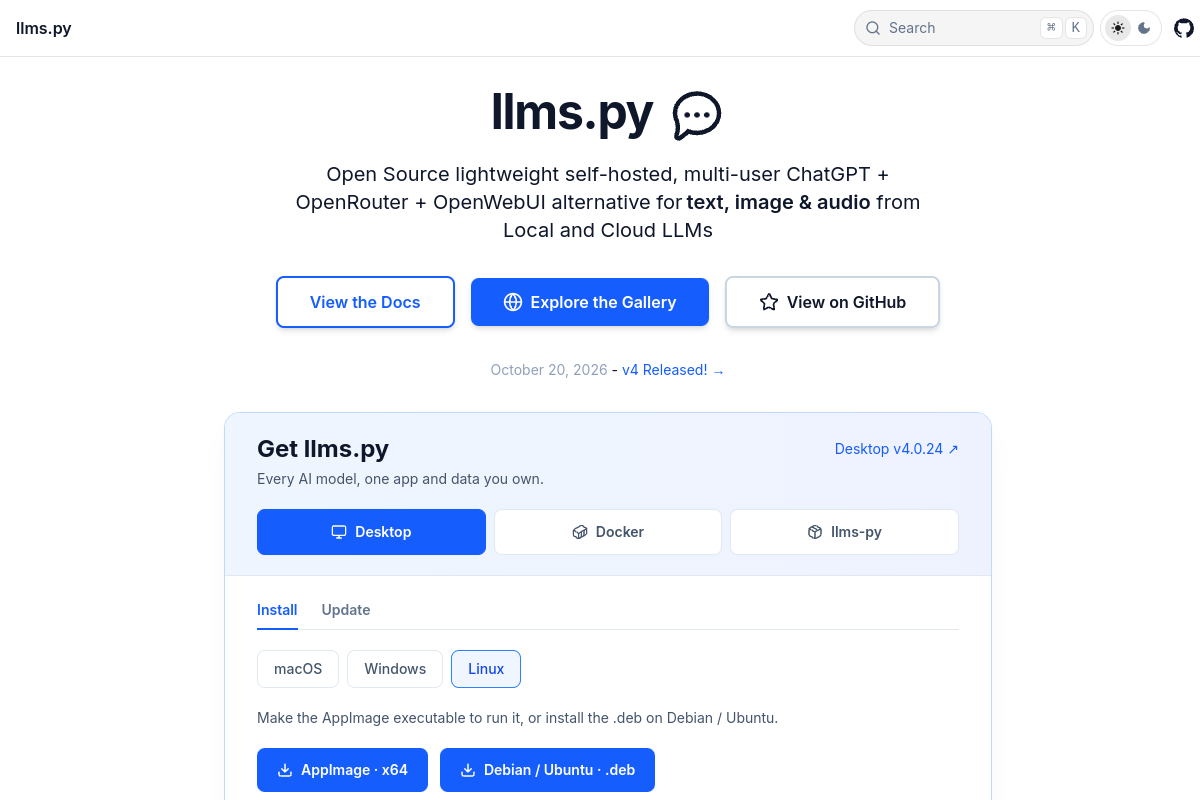
llms.py is a lightweight, self‑hosted gateway built on aiohttp that abstracts 530+ models across 24 providers into a single, consistent API. It solves the fragmentation problem by offering a unified CLI, desktop, and Docker deployment that supports multi‑user authentication and data ownership.
The platform delivers core workflows for text, image, and audio generation through a single web UI, CLI commands, and REST endpoints. Users can chat, create images via Gemini, OpenRouter, or Nvidia, and synthesize speech with Gemini or OpenRouter. The extensible plugin system lets developers add new providers, tools, or UI themes, while Decision Studio and Agent Profiles enable reusable decision logic and AI agents.
llms.py targets developers, data scientists, and product teams who need rapid prototyping without vendor lock‑in. It delivers measurable ROI by cutting integration time by 70% and saving teams hours of manual configuration, making it ideal for small to medium‑sized teams that value privacy and control.
llms.py is a lightweight, self‑hosted gateway that aggregates 530+ LLMs from 24 providers into a single API. It runs as a Docker container, desktop app, or CLI, and exposes a web UI, REST endpoints, and command‑line commands for chat, image, and audio generation. Users can authenticate, manage projects, and publish content to a public gallery.
llms.py is free and open source; there is no paid tier or trial. You can download the Docker image, desktop binaries, or install via pip and run it locally or on your own servers.
It is ideal for developers, data scientists, and product teams who need rapid experimentation with multiple LLMs without vendor lock‑in. It also suits open‑source enthusiasts who want full control over data and deployment.
llms.py supports 530+ models from 24 providers (OpenAI, Gemini, OpenRouter, Nvidia, etc.) and offers text, image, and audio modalities. It runs on Windows, macOS, Linux, Docker, and as a CLI, and exposes a REST API and web UI.